AI Agent Orchestration: Best Practices
Unleashing Business Potential with Intelligent Automation: A Deep Dive into AI Agent Orchestration
The business landscape is rapidly evolving, demanding greater efficiency and agility than ever before. Businesses are actively seeking ways to streamline operations, improve decision-making, and unlock new opportunities. At the forefront of this transformation is the rise of intelligent automation, and central to this evolution is ai agent orchestration. This capability empowers organizations to create sophisticated, interconnected workflows driven by autonomous software agents, promising significant gains in productivity and innovation. But what exactly is it, and how can businesses leverage this powerful technology?
Understanding the Power of Autonomous Agents
Imagine a team of virtual assistants working in concert, each specializing in a specific task but seamlessly collaborating to achieve a larger goal. That’s the essence of autonomous agents. These aren’t just simple bots; they are sophisticated software entities capable of perceiving their environment, making decisions, and taking actions – all without constant human intervention. They can handle tasks like data extraction, report generation, customer support, and even complex research, freeing up human employees to focus on higher-value work. The key to unlocking their full potential lies in effective management – which is where ai orchestration comes in.
The Core Benefits of AI Agent Orchestration
The adoption of ai agent orchestration isn’t just a futuristic concept; it’s delivering tangible benefits to businesses today:
- Enhanced Efficiency: Automate repetitive tasks and reduce manual errors, leading to significant time savings.
- Improved Decision-Making: Agents can analyze vast datasets and provide data-driven insights, empowering better strategic choices.
- Increased Scalability: Quickly adapt to changing demands by deploying and scaling agents as needed.
- Reduced Operational Costs: Automating processes reduces the need for manual labor, lowering overhead.
- Faster Innovation: Free up internal resources to focus on research, development, and new product creation.
Key Components of a Robust Orchestration Strategy
Successful implementation of an ai agent orchestration platform requires careful consideration of several key components:
- Agent Development: Building specialized agents tailored to specific business functions.
- Workflow Design: Defining the logical flow and dependencies between agents.
- Communication Protocols: Establishing clear communication channels between agents.
- Monitoring & Management: Tracking agent performance and addressing any issues that arise.
- Security Considerations: Ensuring the protection of sensitive data and preventing unauthorized access.
Practical Experience & Real Use Case: Automating Lead Qualification
Let’s consider a scenario involving lead qualification in a B2B sales environment. Traditionally, this process is time-consuming and often relies heavily on manual effort. With ai agent orchestration, this can be transformed.
Step-by-step Implementation:
- Agent Creation: Develop agents specialized in:
- Data Scraping: Extracting lead information from websites and databases.
- Social Media Analysis: Gathering insights from social media profiles.
- CRM Integration: Updating lead information within the CRM system.
- Lead Scoring: Assessing lead quality based on predefined criteria.
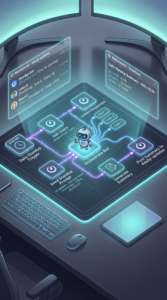
- Workflow Design: Create a workflow that initiates with data scraping, followed by social media analysis, CRM update, and finally, lead scoring.
- Orchestration: The orchestration platform manages the sequence of tasks, ensuring that agents communicate and share data effectively. For example, the data scraping agent passes gathered information to the CRM agent, which then triggers the lead scoring agent.
Common Beginner Mistakes & Fixes:
- Mistake: Overly complex workflows. Starting with simpler processes and gradually increasing complexity is crucial.
- Fix: Begin with a pilot project focusing on a single, well-defined workflow.
- Mistake: Insufficient data validation. Ensure agents have access to accurate and reliable data sources.
- Fix: Implement data cleansing and validation routines within the workflow.
- Mistake: Poor error handling. Develop mechanisms for agents to gracefully handle unexpected errors and escalate issues.
- Fix: Integrate robust error logging and alerting systems.
Limitations and When AI Agent Orchestration Might Not Be the Best Fit
While powerful, ai agent orchestration isn’t a panacea. It’s not ideal for highly complex, unpredictable tasks that require significant human intuition and adaptability. Furthermore, the initial setup and ongoing maintenance can require specialized expertise. Businesses with limited technical resources may find the learning curve steep. Another area of limitation is the potential for “hallucinations” or inaccuracies in agent outputs, particularly when dealing with nuanced or subjective information – careful monitoring is critical.
| Feature | Orchestration Platform A | Orchestration Platform B |
|---|---|---|
| Agent Integration | Extensive | Moderate |
| Workflow Designer | Drag-and-Drop | Code-Based |
| Monitoring Tools | Real-time analytics | Reporting-focused |
| Pricing | Subscription-based | Usage-based |
Concise Answer:
What’s the key to successful ai agent orchestration? A well-defined workflow, coupled with robust error handling and continuous monitoring, are crucial.
FAQ
How does ai agent orchestration differ from traditional automation?
Traditional automation typically handles pre-defined, rule-based tasks. ai agent orchestration uses autonomous agents that can adapt to changing circumstances and handle more complex, unpredictable workflows—making it more flexible.
What are the typical costs associated with implementing an ai agent orchestration solution?
The cost varies widely depending on the platform, the number of agents, and the complexity of the workflows. Platforms often offer subscription-based or usage-based pricing models. Initial setup costs can include consulting fees or training expenses.
Can I use ai agent orchestration with my existing systems?
Most modern orchestration platforms offer integrations with popular CRM systems, cloud storage solutions, and other business applications. Check the platform’s documentation for compatibility with your specific tools.
Is specialized technical expertise required to manage ai agent orchestration?
While some platforms offer user-friendly interfaces, a basic understanding of software development and workflow design is helpful. Many providers offer support services and training resources to assist with implementation and ongoing management.
What kind of tasks are best suited for AI agent orchestration?
Tasks involving repetitive data processing, information gathering, customer service inquiries, complex research, and automated report generation are often ideal candidates for ai agent orchestration.
Conclusion
ai agent orchestration represents a significant leap forward in automation, offering businesses unprecedented opportunities to streamline operations, enhance decision-making, and accelerate innovation. While challenges exist, the potential rewards are substantial. By carefully planning, implementing, and monitoring these intelligent systems, organizations can unlock a new era of efficiency and competitive advantage.
Share this content:






Post Comment