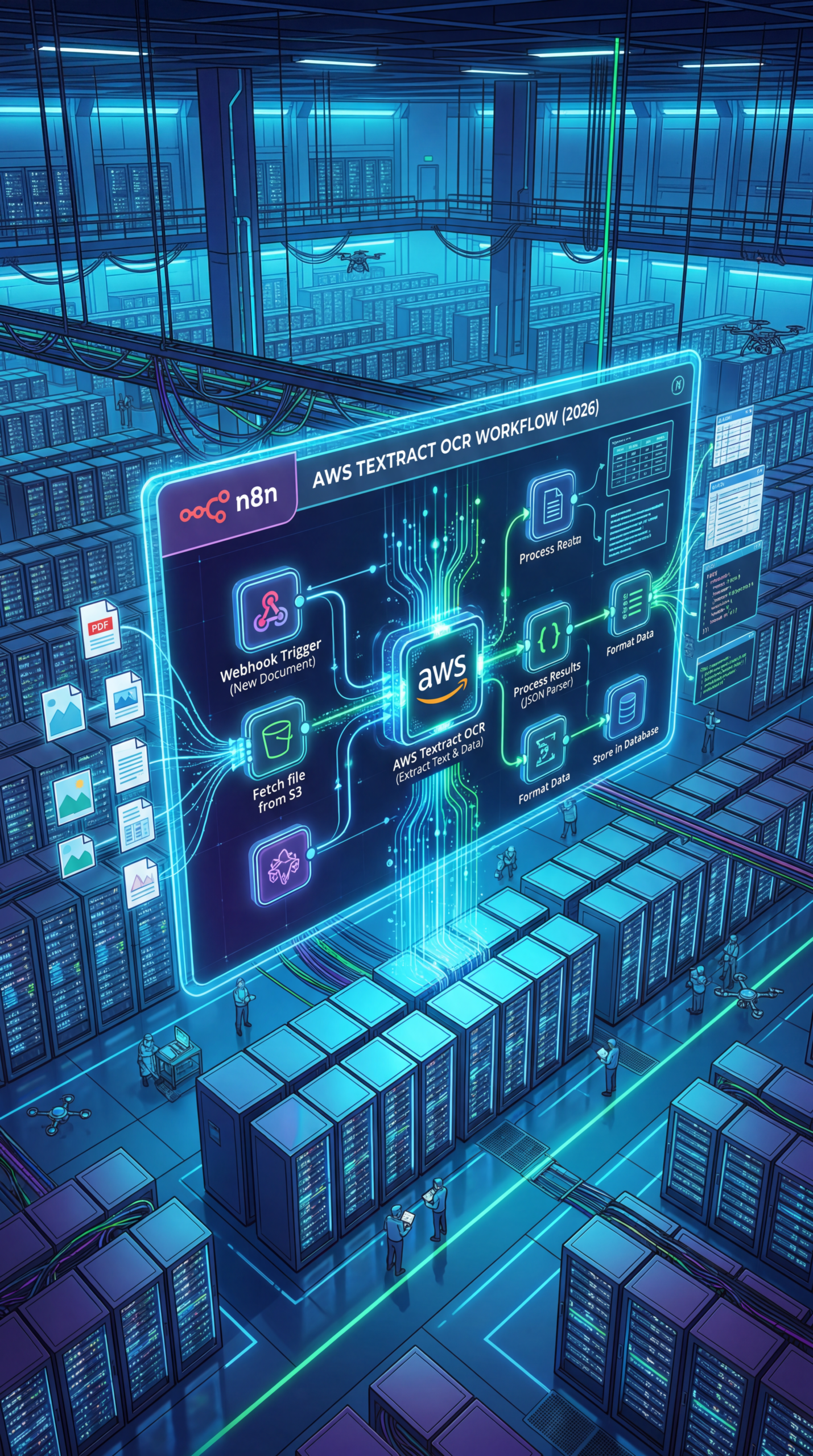
n8n AWS Textract OCR Workflow Guide 2026
Streamlining Document Processing: Mastering the n8n AWS Textract OCR Workflow 2026
In today’s data-driven world, extracting information from documents is a critical, yet often time-consuming, task. Businesses across industries grapple with mountains of invoices, contracts, receipts, and other unstructured data. Fortunately, powerful tools like AWS Textract, coupled with automation platforms like n8n, are revolutionizing this process. This article explores the practicalities of implementing a robust n8n AWS Textract OCR workflow 2026 to efficiently process documents, unlock valuable insights, and boost operational efficiency. We’ll delve into setup, common pitfalls, and future trends in this area.
Understanding the Power of AWS Textract and n8n
AWS Textract is a fully managed service that uses machine learning to automatically extract text and data from scanned documents. It goes beyond simple Optical Character Recognition (OCR) to identify key-value pairs, tables, and forms within images. This capability significantly reduces the manual effort required to process these documents. n8n, an open-source workflow automation tool, provides a visual interface to connect various applications and services – making it ideal for orchestrating a complete document processing pipeline.
The combination of these two technologies allows you to create powerful automated processes. Imagine effortlessly converting scanned invoices into structured data that can be directly imported into your accounting system. That’s the promise of an effective AWS Textract automation, n8n OCR workflow, S3 document processing, invoice data extraction 2026, automated OCR pipeline.
Building Your n8n AWS Textract Workflow: A Step-by-Step Guide
Creating a seamless n8n AWS Textract OCR workflow 2026 involves several key steps:
- Setting up your AWS Account and Textract: You’ll need an AWS account and to enable the Textract service. This involves configuring IAM roles with appropriate permissions to access your S3 bucket and Textract. Consider using AWS console or AWS CLI to set these up.
- Creating an S3 Bucket: An S3 bucket serves as a storage location for your documents. Configure the bucket permissions to allow Textract to access files.
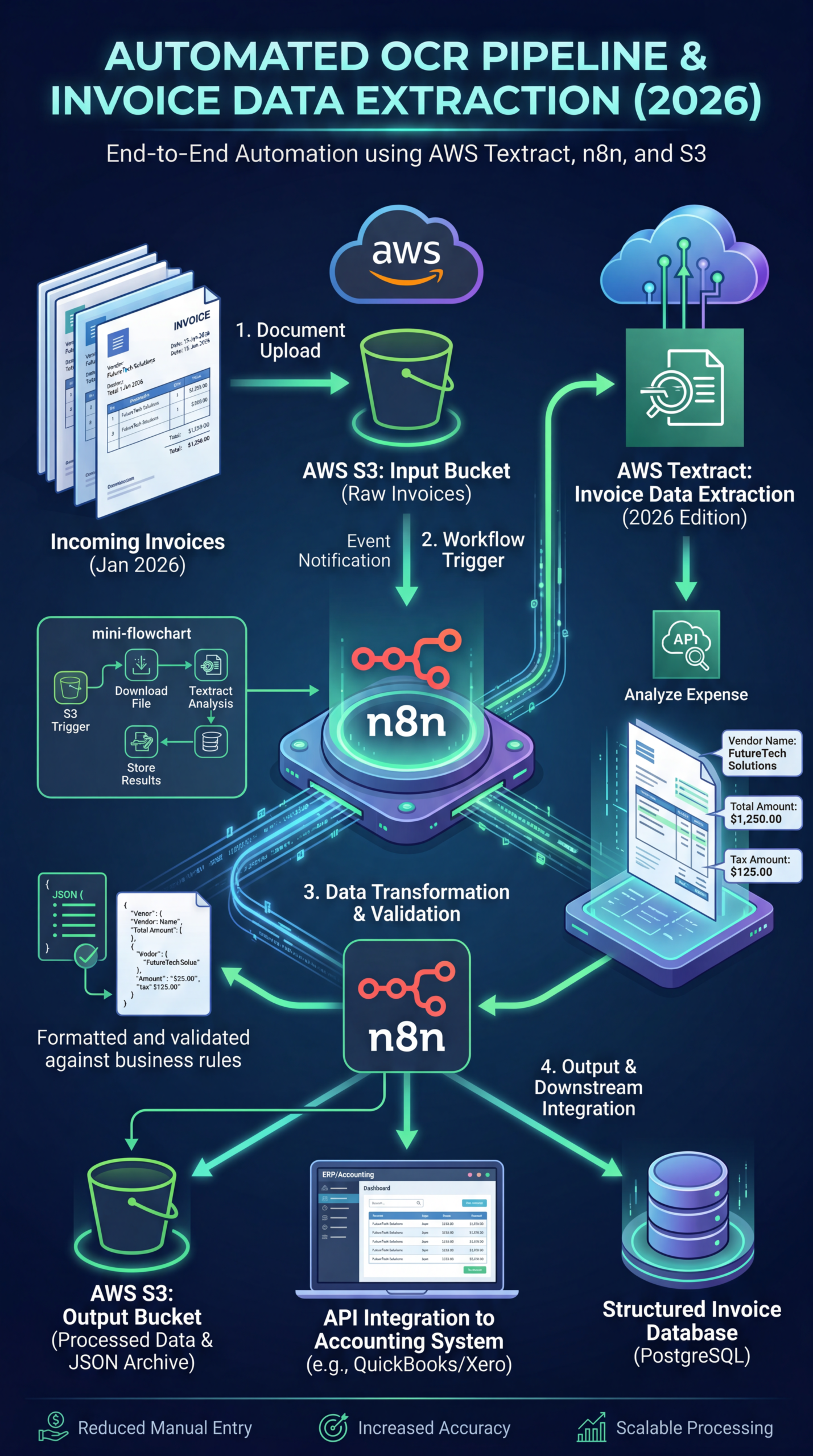
- Designing the n8n Workflow: In n8n, you’ll start with a trigger (e.g., a file uploaded to S3), then a function to call the AWS Textract API, and finally steps to process the extracted data.
- Textract API Integration: The n8n AWS Amazon function allows direct interaction with the Textract API. You’ll configure API parameters, such as document location, features to extract, and language.
- Data Processing & Storage: After Textract extracts the data, you can parse the JSON output and store it in a database (like PostgreSQL or MySQL), a spreadsheet (like Google Sheets or Excel), or send it to another application via API.
Practical Experience & Real Use Case
Let’s consider a scenario: Automating the processing of supplier invoices. A common beginner mistake is not properly configuring the S3 bucket permissions, leading to Textract being unable to access the files. This results in workflow failures. Another frequent issue is not handling varied invoice formats; each supplier might have a different layout. This might necessitate implementing logic within n8n to handle these variations, perhaps using conditional statements or multiple Textract calls with different configurations.
A practical approach involves:
- A webhook trigger when a new invoice is uploaded to the S3 bucket.
- The workflow retrieves the invoice from S3.
- It calls the AWS Textract API, specifying the document and the desired extraction features (e.g., key-value pairs for invoice number, date, amount).
- The workflow parses the JSON output from Textract.
- It validates the extracted data against expected formats.
- Finally, it updates a database with the invoice details.
Using a tool like n8n’s built-in functions streamlines this process significantly.
Limitations and Considerations
While powerful, this approach isn’t a silver bullet. One limitation is handling complex document layouts with heavy graphics or unusual formats. Textract works best with relatively clean, well-structured documents. Some document formats also require pre-processing steps like deskewing or noise reduction before being sent to Textract. The cost of using AWS Textract can also be a factor, especially for large volumes of documents. Carefully evaluate the cost versus the benefits before implementation.
Comparing Options: OCR Tools for Document Automation
| Feature | AWS Textract | Google Cloud Document AI | Azure Form Recognizer |
|---|---|---|---|
| Accuracy | High | High | High |
| Key-Value Extraction | Excellent | Good | Good |
| Table Detection | Excellent | Good | Good |
| Pricing | Pay-per-use | Pay-per-use | Pay-per-use |
| Ease of Integration | Good | Good | Good |
Note: This is a simplified comparison. Actual performance may vary based on document complexity and specific use case.
Snippet Answer:
How does an n8n workflow help with AWS Textract OCR?
An n8n workflow acts as the orchestrator, connecting your documents in S3 to AWS Textract for data extraction. It automates the entire process – from triggering upon file uploads to storing extracted data – saving time and reducing manual effort.
Future Trends in Document Automation
The ongoing advancements in machine learning will further enhance the accuracy and capabilities of OCR tools like AWS Textract. Expect improved support for complex document layouts and greater ability to handle handwritten text. Furthermore, the rise of generative AI will integrate with these workflows, allowing for automated data validation, summary generation, and even intelligent document classification. These advancements will improve the efficiency of the n8n AWS Textract OCR workflow 2026 even further.
Frequently Asked Questions
What does n8n AWS Textract OCR workflow 2026 actually do?
It automates the process of extracting data from documents stored in AWS S3, using AWS Textract’s OCR capabilities, and then processes and stores that data. This eliminates manual data entry.
Is this solution suitable for handling handwritten documents?
While AWS Textract has improved handwritten text recognition, it still performs best with printed documents. For heavily handwritten documents, additional pre-processing or specialized tools may be required. AWS Textract automation, n8n OCR workflow, S3 document processing, invoice data extraction 2026, automated OCR pipeline is constantly evolving.
What are the main benefits of using n8n with AWS Textract?
The primary advantages are automation, reduced manual effort, improved accuracy, and seamless integration with other applications within your workflow.
How can I build an automated workflow to extract data from receipts?
You would set up an S3 bucket to receive uploaded receipts, configure an n8n workflow to trigger on new files, call the AWS Textract API with the receipt image, and then parse the extracted data to store it in a designated location.
Are there any costs associated with using this setup?
Yes, you’ll incur costs for AWS Textract usage (based on the number of pages processed) and for any other services you integrate with (like S3 storage or database services).
Conclusion
Implementing an n8n AWS Textract OCR workflow 2026 is a powerful way to automate document processing, save time, and unlock valuable insights from your unstructured data. While there are considerations regarding document complexity and costs, the benefits of automation often outweigh the challenges. By understanding the key steps involved and addressing common pitfalls, you can build a robust workflow that streamlines your document management processes.
Ready to take your document processing to the next level? Share your experiences with n8n AWS Textract OCR workflow 2026 in the comments below! Or, explore other automation possibilities by checking out our article on integrating n8n with Google Sheets.
Share this content:











Post Comment